Balcony or Floor: Which View Suits Your Listening?
Balcony or floor seating changes how you see and hear a concert. Compare sightlines, distance and stage detail to choose the view that suits you.
You open a seating plan and pause over the choice: a floor seat near the stage, or a balcony seat with the whole ensemble in view. For balcony or floor concert seating, the useful question is not simply which is closer. It is which view helps you follow the performance you came to hear.
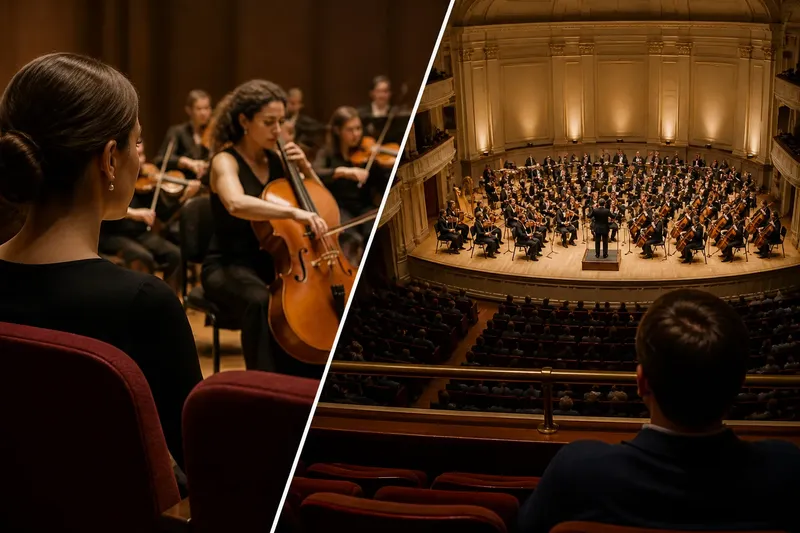
A seat changes the picture as much as the distance. From the floor, a musician’s expression or a soloist’s bow arm may hold your attention; from a balcony, you can watch the group’s shape and see how players respond to one another. Neither view is automatically better. The right one depends on what you want your eyes to do while you listen.
What does the floor let you notice?
Floor seats bring performers into a more immediate visual scale. You may see a singer turn towards the orchestra, a pianist settle into a phrase, or a percussionist prepare for an entrance. That closeness can make an intimate recital feel especially direct.
It can also narrow the scene. If the stage is high or the seats are flat, people in front may obscure parts of the performance. In a large ensemble, a close view can leave you tracking one musician at a time rather than taking in the full arrangement.
Floor seating often suits listeners who enjoy facial expression, physical gesture and the feeling of being near the action. It can be a particularly appealing choice for a solo recital or a small group, where the details of interaction are easy to follow. Consider the venue’s seating layout, though: “floor” describes a level, not a promise of an unobstructed view.
Why choose a balcony seat?
A balcony usually offers a broader picture. You can see how sections are positioned, watch a conductor’s cues travel across the stage and follow changes in the ensemble’s balance. For a large orchestra, chorus or staged concert, that overview can make the performance easier to read as a whole.
The trade-off is distance. Small gestures and facial expressions may be harder to pick out, and a balcony’s angle can make performers seem less immediate. Some balconies also have side seats where a rail or the shape of the room affects the view, so a seating chart is more useful when it shows individual sections rather than a single shaded area.
Choose the balcony if you value shape, coordination and a clear view of the stage picture more than close-up detail. It can also suit a listener who likes to settle into the sound without having a single performer dominate the visual field. A broad view is a little like looking at a map instead of following one turning car: you gain the layout, though not every small movement.
Which seat fits your way of listening?
Start with the kind of attention you enjoy. If you naturally watch hands, faces or a lead performer, look for a floor seat with a clear line to that part of the stage. If you prefer to hear how musical parts fit together, a central balcony position may make the ensemble easier to follow.
Then consider the performance itself. A solo singer or chamber group offers more to see at close range than a large ensemble spread across a deep stage. For a full orchestra, an elevated view can reveal entrances and exchanges that are difficult to track from a low angle. These are tendencies, not rules: a venue’s architecture can change the experience.
Imagine you are choosing between a near-floor seat behind several rows and a central balcony seat for an orchestral concert. If watching the conductor and sections interact matters most, the balcony may be the more satisfying fit; if you are drawn to a particular soloist’s expression, compare floor seats with a clear, direct sightline instead of choosing by distance alone.
What should you check before choosing a concert seat?
Does the seating chart show the actual stage angle?
Look for the stage orientation and any marked restricted-view sections, then check whether your seat faces the performers or sits to one side. A seat that appears close on a plan may offer a less direct view than a more distant central position.
Could someone in front block the floor view?
Check whether the floor is flat, tiered or arranged with a raised platform, if that information is available. On a flat floor, a clear sightline can depend more on the people seated ahead than it would from an elevated row.
Does the balcony have rails or overhangs?
Look for notes about limited views and inspect the section’s position relative to the stage. A front rail, side angle or overhanging level may shape what you can see, even when the seat is high enough to give a broad view.
Which performers do you most want to watch?
Identify the soloist, conductor or stage area you expect to follow, then compare that point with the seat’s angle. When a venue provides a seat-view image, use it as a guide to sightlines rather than assuming it can capture the full experience.
Can sound settle a close call?
Visual preference can lead the decision, but the room’s acoustics matter too. Sound may feel different across the floor and balcony because of the hall’s shape, reflective surfaces and seat position. A seating plan rarely tells the whole story, so venue-specific seating notes can help if they are available.
When two seats seem equally appealing, choose based on the performance’s visual character: close detail for a small-scale recital, or a wider view for a large ensemble. If sound access or a particular seat feature matters to you, check the venue’s own information before booking; layouts and seating arrangements vary.
For balcony or floor concert seating, think of the choice as a decision about attention: do you want to stay close to one performer, or see relationships across the stage? That single preference can make the seating plan much easier to read—and leave you better placed to enjoy the performance once the lights dim.